Contents
This article reflects the state of our research and is not legal or tax advice. What applies to your property depends on the zone, the municipality, the house rules and your contract; only the competent authority gives binding information.
Key facts
- Anyone leaving Switzerland and keeping the flat remains liable to limited taxation here.
- That requires an address for service in Switzerland — official post is not delivered abroad.
- Short-term letting keeps the flat available if a return is conceivable; if a return is ruled out, long-term renting is simpler.
- To settle before the move: bank, insurance, the zoning question at the municipality, and for condominiums the regulations.
Tax liability does not end with the move
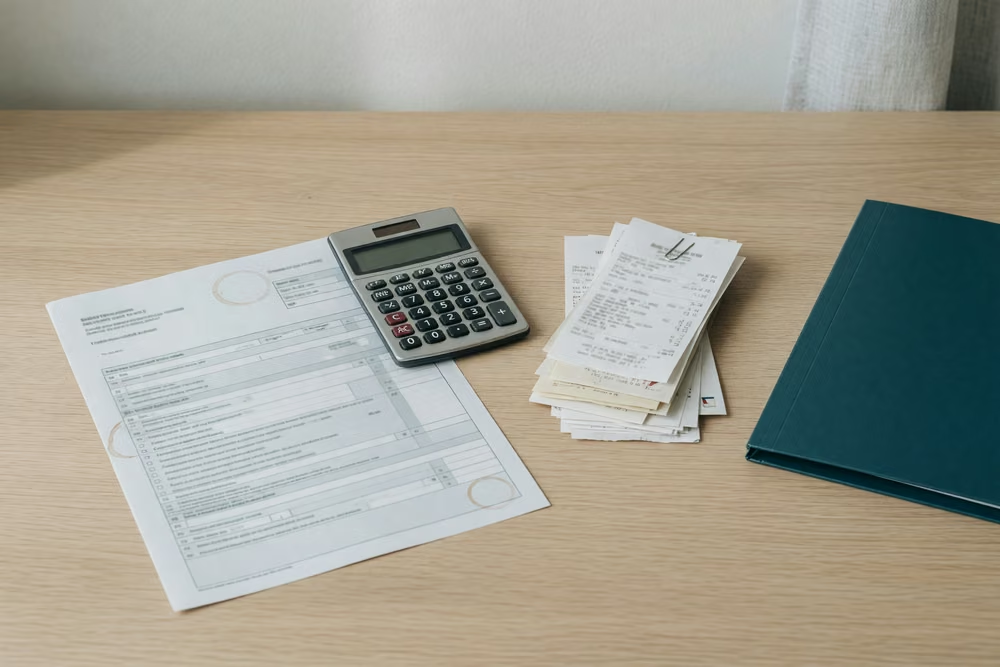
Anyone moving abroad and keeping a property in Switzerland becomes subject to limited tax liability in the canton where the property lies. That is the principle in international tax law: a property is taxed where it is situated — regardless of where the owner lives.
In practice that means: you continue to declare the flat and the income from it in Zurich, and your new country of residence either exempts it or credits the Swiss tax, depending on the double taxation agreement. A tax return still has to be filed.
What surprises many: limited tax liability covers not only the rental income but the wealth as well — the tax value of the property remains within Swiss wealth tax.
The address for service in Switzerland
This is the point at which things fail in daily life. An address in Switzerland has to be designated for the service of tax assessments and invoices. Without one you will miss deadlines, and a missed objection deadline against a discretionary assessment costs money.
Who takes on that role is your decision: a fiduciary (Treuhandstelle), a family member, a lawyer. What matters is that the person actually opens the post and forwards it — an address at which nobody looks is worse than none.
What we do not take on here: the representation itself and the tax handling. We supply the occupancy data and the monthly statements in a form your fiduciary can use.
Your figures, not our examples
The calculator takes the number of rooms, the neighbourhood and the fit-out and shows you a range — with the arithmetic beside it, not as a single figure you have to take on trust.
Estimate the returnShort-term letting or a long-term tenant while you are away
From a distance, everything appears at first sight to favour a long-term tenant: one figure a month, one point of contact, little administration. Two things speak against it.
First, coming back. A long-term lease cannot be ended at short notice; personal need (Eigenbedarf) is a ground for termination with notice periods and a right of challenge. Anyone wanting to return in two years, or leaving it open, ties themselves down more with a long-term tenant than they expect.
Second, control over the condition. With short-term letting somebody looks inside the flat after every stay; a water leak comes to light within days, not months. With a long-term tenant you learn of a problem when they report it.
- Return planned within a foreseeable time or left open: short-term letting keeps the flat free.
- Return ruled out, sale in a few years: a long-term tenancy is simpler, and protection against termination is the buyer’s concern on a sale.
- To be clarified in both cases: admissibility under zoning law with the municipality, and with condominium ownership the association’s rules.
What to settle before the move
Four things, and all four are more laborious from a distance than beforehand.
The address for service, as above. The bank: a change of residence abroad can affect mortgage terms, and so can a change of use from own occupation to letting — tell your bank in writing before you go. The insurance: household contents policies regularly exclude commercial use, and a flat standing empty or let is a different thing in insurance terms from one lived in. And the post: forwarding abroad does not run indefinitely.
If you want the flat let for you, the first conversation belongs before the move, not after. We need access once for the viewing and the photography — organising that from abroad costs more time than beforehand.
Frequently asked questions
Yes. A property is taxed where it is situated. You remain subject to limited tax liability in the canton of Zurich, for the income and for the tax value. How your new country of residence treats that depends on the double taxation agreement.
For the service of assessments and invoices, yes. Anyone not designating one risks missed deadlines — and a discretionary assessment that can no longer be challenged is expensive.
The operation, yes: listing, prices, guests, cleaning, monthly statement. Not the tax representation and not the guest registration with the canton — the duty to register lies with the host and is not transferable. We supply the occupancy data for it.
And for your property?
Sources
State of our research: 31 July 2026. Official rules change — check the current position with the competent authority.