Contents
Key facts
- Most rejected damage claims fail not on the damage but on the missing record of how it looked before.
- So the mistake happens before the damage: photographs of the condition belong before the first booking and in the cleaning routine.
- AirCover covers a good deal, but not everything — wear is not damage, it is a line in the calculation.
- Contents insurance does not apply automatically: many policies exclude commercial use.
The mistake happens before the damage
From first-hand accounts in host communities, one point recurs so regularly that it can be taken as a rule: anyone claiming for damage rarely fails because the damage is disputed. They fail because they cannot show what the flat looked like beforehand.
A scratch in the parquet, a stain on the sofa, a crack in the shower door — none of the three can be attributed without a before picture. And without attribution there is no reimbursement, regardless of who actually caused it.
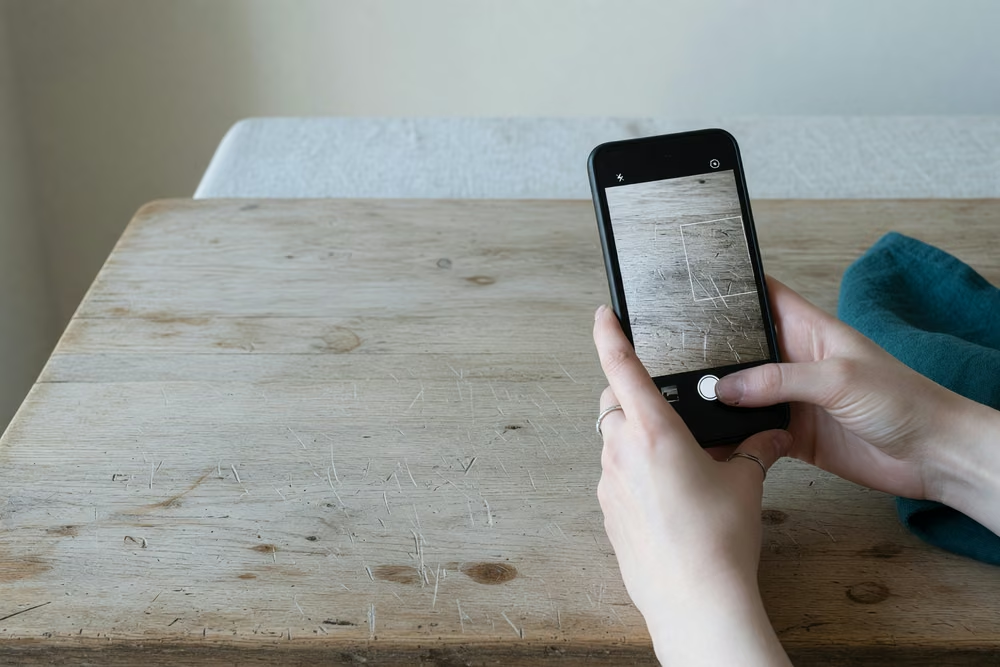
What helps takes little effort and is rarely done: a complete photo series after every deep clean, with the date. Not listing photographs — those are flattering and do not show the corners that matter. Rather plain shots of every surface that can be damaged.
What AirCover covers and what it does not
AirCover is the protection Airbnb offers hosts. What it covers in detail is stated by Airbnb itself; the conditions change and should be read there, not in a guide.
What emerges from the first-hand accounts is a structural limit that applies regardless of the detail: AirCover is tied to the platform. Damage arising on a booking made through another platform or directly is not covered by it. Anyone letting through several channels therefore has no such protection for part of their bookings.
The second limit: wear is not damage. A sofa worn through after two years of short-term letting is an item in the calculation, not an insurance claim. Anyone not reckoning with that is not budgeting for the replacement of textiles and upholstered furniture — and that falls due considerably sooner under short-term letting than under a long-term tenancy.
Your figures, not our examples
The calculator takes the number of rooms, the neighbourhood and the fit-out and shows you a range — with the arithmetic beside it, not as a single figure you have to take on trust.
Estimate the returnWhy household contents insurance does not respond automatically
An ordinary household contents policy covers private use. Commercial accommodation is not private use. Anyone switching without notifying risks having the claim declined — not because of the damage, but because of the unreported change of use.
It is the same mechanism as with the mortgage: the switch itself is permissible, the concealment is the problem. A call to the insurer takes ten minutes and establishes whether an adjustment is needed.
Liability cover should be checked as well: if a guest is injured in the flat, that is a different case from damage to the furniture — and one involving considerably larger sums.
Frequently asked questions
No, for two structural reasons. First, AirCover is tied to the platform: bookings through other channels or made directly are not covered. Anyone letting through several platforms has no such protection for part of their bookings. Second, it covers damage, not wear — a sofa worn through after two years is an item in the calculation, not an insurance claim. On top of that: your ordinary household contents policy covers private use, and commercial accommodation is not that. Without notifying your insurer you risk having a claim declined because of the unreported change of use.
Plain shots of every surface that can be damaged, after every deep clean, with the date. Not the listing photographs: those are flattering, wide-angle and precisely do not show the corners that matter in a dispute. From first-hand accounts, most rejected damage claims fail not because the damage is disputed but because the host cannot show what it looked like beforehand. A scratch in the parquet with no before picture cannot be attributed to anyone — and without attribution there is no reimbursement, regardless of who caused it.
Yes, and the call takes ten minutes. An ordinary household contents policy covers private use; commercial accommodation is not private use. Anyone switching without notifying risks having a claim declined — not because of the damage, but because of the unreported change of use. It is the same mechanism as with the mortgage: the switch is permissible, the concealment is the problem. In the same conversation, check the liability cover: an injured guest is a different and considerably more expensive case than damage to the furniture.
And for your property?
Sources
State of our research: 22 July 2026. Official rules change — check the current position with the competent authority.