Contents
Key facts
- Professional photography lifts the click rate by 20 to 30 per cent; one host reports 17.5 per cent more bookings after changing the photos.
- The title is cut off after about 50 characters — the strongest selling point belongs at the front.
- For strategic title optimisation, trade sources cite up to 40 per cent higher booking rates.
- With amenities, less is more: anything that is not accurate costs you in the «accuracy» sub-category.
The first photo decides the click
In the results list a guest sees one image and a price. Everything else comes afterwards or never. Trade sources name the cover image as the most important element of a listing: it decides whether someone clicks or scrolls on.
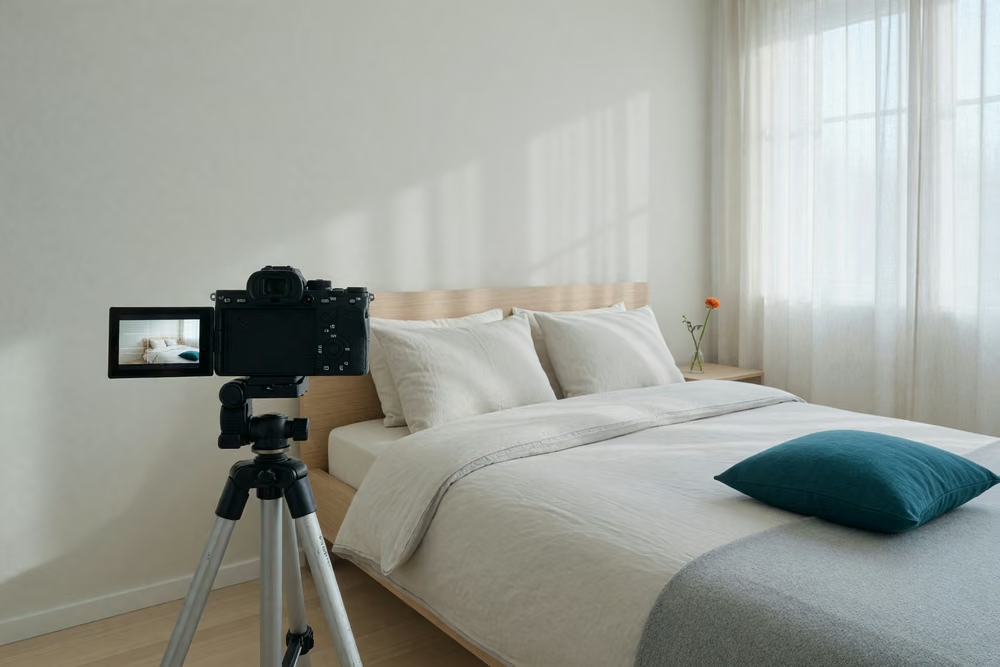
What has a measurable effect: professional photography with daylight, a wide angle and a perspective looking out of the room raises clicks by 20 to 30 per cent. For one host, a 17.5 per cent rise in bookings is reported after changing the photographs.
What the image has to do: show the main room in its depth. A detail — a laid table, an armchair by the window — works in the detail view, not in the overview. There the question is whether the room looks large and bright.
And the warning that goes with it: images brightened or distorted by a wide angle raise expectations. The disappointment on arrival shows up in the «accuracy» sub-category, and that one counts for Guest Favourites.
The first 50 characters
The title is truncated after about 50 characters. Nobody sees what comes after that in the results list. Trade sources cite an increase in the booking rate of up to 40 per cent for strategic title optimisation — with the advice to begin with the strongest selling point: the view, the location, a distinctive feature.
From which a clear recommendation follows: do not begin with «beautiful» or «cosy». Those words appear in thousands of titles, they distinguish nothing, and they consume a fifth of the visible title.
For Zurich, concretely: «2 min to the HB» says more than «central location». «Lake view, balcony» more than «dream apartment». And if a property is next to the trade-fair grounds, that belongs in the title — because that is exactly what people search for.
Your figures, not our examples
The calculator takes the number of rooms, the neighbourhood and the fit-out and shows you a range — with the arithmetic beside it, not as a single figure you have to take on trust.
Estimate the returnThe description: what guests actually read
The description is rarely read from top to bottom. Guests look for answers to three or four questions they have in mind — and if they do not find them, they write to you or book elsewhere.
The questions are predictable: how do I get there? Where do we sleep? Is there Wi-Fi good enough for work? What is nearby? Can I arrive early or leave late?
From that follows a structure that has proved itself: first the location in concrete terms — walking minutes, tram lines, journey time to the airport, not «well connected». Then the layout, stating clearly how many people sleep where. Then the amenities that matter for the stay. And finally the two or three things that might bother somebody.
Amenities: less is more
The temptation to tick everything that is somehow present has a price. If a guest cannot find a ticked amenity — or does not find it in the expected form — the rating in the «accuracy» sub-category drops.
A common example: «workspace». What was meant was the kitchen table. A business traveller expecting a screen and a socket within reach rates that as a misstatement. Anyone not ticking the workspace loses a few views from business travellers — anyone ticking it wrongly loses rating points.
Conversely there are amenities that work more strongly than their cost suggests: a washing machine in the flat, self check-in without anyone present, free Wi-Fi with the speed stated. They are used as filters — anyone not listing them does not appear in filtered searches.
How to check whether it works
The figure that matters is the conversion rate: how many of the guests who view the listing book it. According to trade sources it is the most important ranking factor in the algorithm.
In practice that means: do not track the number of views but the ratio. Rising views with bookings unchanged is a bad sign, not a good one — it means the listing generates attention but does not convince.
And one change at a time. Anyone changing photographs, title and price at once will not know afterwards what worked. Two to three weeks between changes are needed for a difference to show.
Frequently asked questions
Technically longer, but about 50 characters are visible in the results list. Nobody reads what comes after that while scrolling. So the strongest argument belongs at the beginning — not «beautiful».
It is the item with the clearest calculation: 20 to 30 per cent more clicks according to trade sources, and for one host a reported 17.5 per cent rise in bookings. The condition is that the flat matches the image.
No, only those actually present in the expected form. A wrongly ticked «workspace» costs rating points in the accuracy sub-category — and that one counts for Guest Favourites.
And for your property?
Sources
State of our research: 3 June 2026. Official rules change — check the current position with the competent authority.