Contents
Key facts
- Four groups with four patterns: business travellers, trade-fair guests, city breakers, expats between homes.
- They differ in lead time, length of stay and fit-out — not in price alone.
- For the old town and Seefeld, city breakers are the main group: around 59 per cent occupancy at CHF 175 on average.
- Expats are the underrated group: even with a 20 per cent monthly discount, more is left than with back-to-back short stays.
Why the guest segment determines the operation
A listing for everyone is a listing for nobody — and the algorithm punishes that. The most important ranking factor is the conversion rate: how often guests who view a listing book it. A listing that appeals to many and convinces few gets demoted.
It follows that choosing the guest segment is not a marketing exercise but an operational decision. It determines the minimum stay, the fittings, the pricing rhythm and the question of which enquiries you accept.
For Zurich, four groups can be distinguished whose patterns stand clearly apart.
Business travellers: short lead time, little price pressure
They book at short notice, often one to three weeks ahead, usually Monday to Thursday. Price is rarely the main criterion — often a company is paying, and the alternative is a hotel.
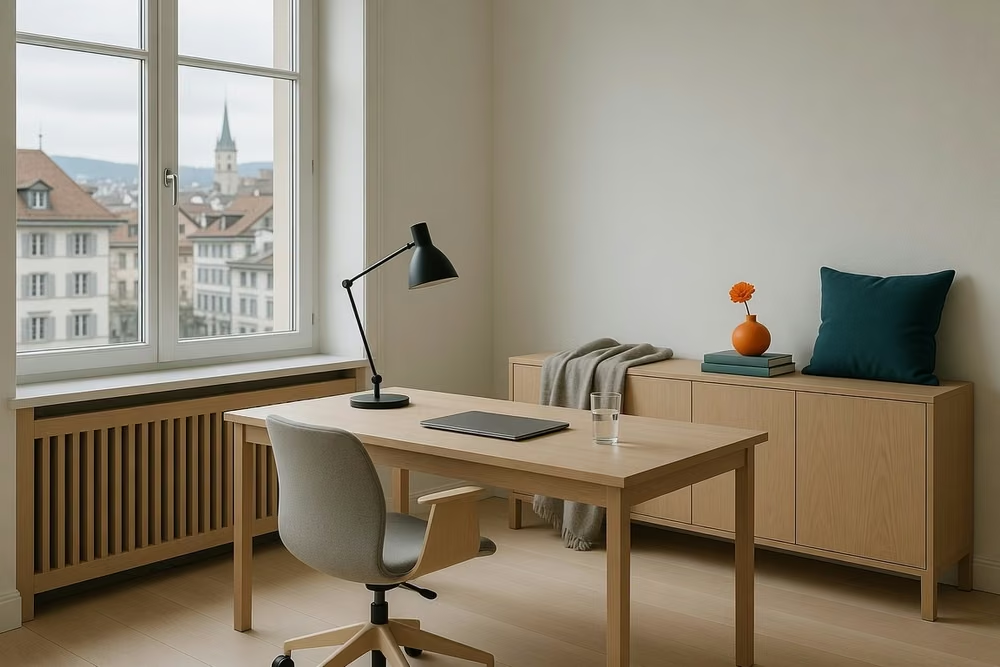
What they need: a real workspace with a table, chair and light. Reliable Wi-Fi with the speed stated. Access without anyone present, because flights are delayed. A washing machine if the stay runs beyond a week. And an invoice with an address, because it has to be expensed.
What they do not need: decoration, kitchen equipment for six people, tips on sights. Anyone addressing this group can economise on some things and should not economise on the workspace.
A practical point: this group produces steady occupancy from Monday to Thursday — precisely the times that stay empty in properties aimed at tourists.
Trade-fair and congress guests: the calendar decides everything
This group depends entirely on dates: Messe Zürich and the Hallenstadion in Oerlikon, the Kongresshaus in the city centre. During major events demand is high and so is willingness to pay; in between it is quiet.
The lead-time pattern is strikingly split in two: one part books very early — six months ahead, because they know it gets expensive later. The rest book very late, when the hotels are full.
What that means for pricing: dates with known major events belong set early and set high. A tool recognises the demand only once the early bookings are in the system — by then the cheap price has already been given away.
For Oerlikon and the surrounding area this group is the most important driver of demand. Anyone with a property there who does not know the events calendar is leaving income on the table — not visibly, but as a booking that was too cheap.
Your figures, not our examples
The calculator takes the number of rooms, the neighbourhood and the fit-out and shows you a range — with the arithmetic beside it, not as a single figure you have to take on trust.
Estimate the returnCity breakers: long lead time, high expectations
They plan two to four months ahead, come at weekends and in the summer months, and they compare carefully. For the Altstadt and Seefeld this is the main group — market data there cites around 59 per cent occupancy at an average price of CHF 175.
What they need: location, and in verifiable terms. Walking minutes to the sights, not «centrally located». A kitchen that is genuinely usable. And photographs that deliver what they show — this group reads reviews closely and writes them closely.
What decides the review here is the accuracy of the listing. Anyone planning a week ahead and then finding something other than expected reviews the discrepancy, not the flat.
Expats and project assignments: the underrated group
Anyone coming to Zurich for a project assignment or between two flats is looking for three weeks to three months — and is economically the most interesting group, because the cleaning cost per franc of revenue is lowest.
A stay of one month means one cleaning changeover instead of twelve. At CHF 80 to 250 per changeover that is the largest difference the length of stay can make. Even with a monthly discount of 20 per cent, more remains than with continuous short stays.
What this group needs: a washing machine, a real kitchen, a workspace, storage for suitcases. And a flat you can live in — not one you spend the night in. By Lake Zurich and in quieter city districts that is the obvious orientation.
A legal point: for stays over three months a different assessment can apply under tenancy law than for short-term letting. And in rules prohibiting «hotel-like operations», furnished letting with a minimum term of three months frequently does not fall within them — that can be the route which works without a resolution of the association.
Frequently asked questions
Measured against the effort: longer stays, that is expats and project assignments. A monthly guest means one cleaning changeover instead of twelve — at CHF 80 to 250 per changeover, the largest difference the length of stay makes.
To a limited extent. Business travellers and city breakers can be combined, because they occupy different days of the week. But anyone addressing everyone lowers the conversion rate — and that is the most important ranking factor.
A real workspace with a table, chair and light. Wi-Fi with the speed stated. Access without anyone present. An invoice with an address for the expense claim. And a minimum stay of two nights, no more — this group books Monday to Thursday.
And for your property?
Sources
State of our research: 18 June 2026. Official rules change — check the current position with the competent authority.