Contents
Key facts
- There is an order: first what decides the booking, then what makes the stay pleasant.
- Textiles in threes, not pairs: one on the bed, one ready, one in the wash.
- The electronic lock changes daily life most — handover no longer requires anyone to be there.
- A desk with a chair and proper light opens up the guest group with the longer stays.
The order in which to fit out
Fitting out is usually planned room by room — bedroom, kitchen, bathroom. It makes more sense to order it by effect: what prevents poor reviews, what raises the price, what is a matter of taste.
First group, without which it does not work: beds with proper mattresses, blackout blinds, a functioning kitchen with crockery for the maximum number of guests, textiles in several sets, reliable Wi-Fi. If one of those is missing, reviews arise that depress the price lastingly.
Second group, which raises the price: an electronic lock, a washing machine in the flat, a real workspace, a balcony or a view where there is one.
Third group, which achieves nothing: designer furniture, decoration, high-end individual pieces. Guests rate cleanliness, accuracy of the listing, communication, location, amenities and value. There is no sub-category for design ambition.
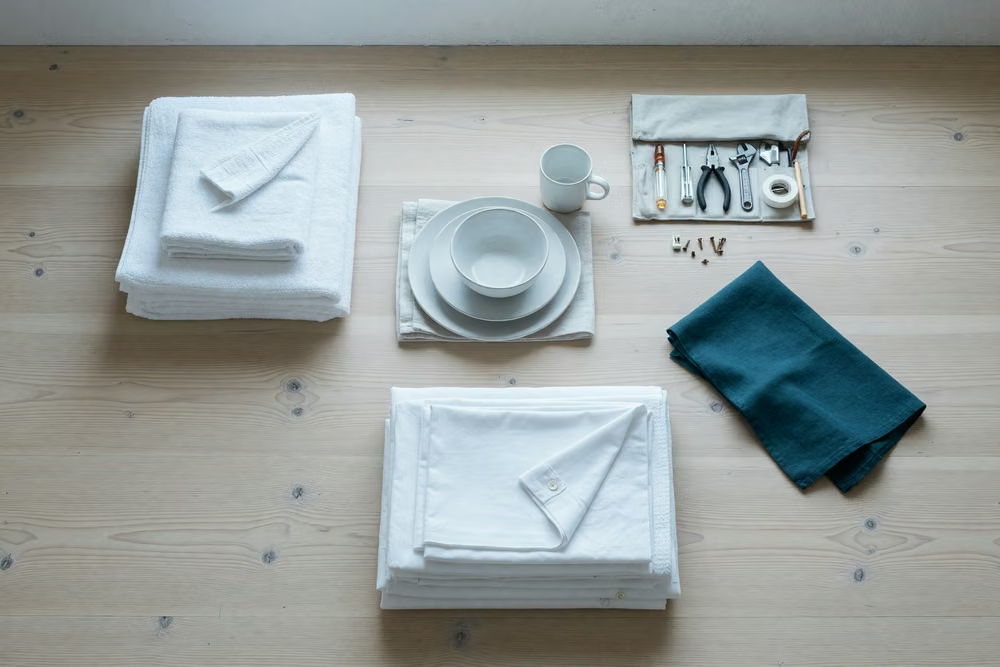
Textiles: why three sets and not two
The most frequent miscalculation in fitting out. Two sets sounds sufficient: one on the bed, one ready. Until the changeover falls on Saturday while Friday’s set is still in the wash.
With changeovers on consecutive days — frequent in Zurich, because business travellers stay Monday to Thursday and weekend guests arrive on Friday — two sets are not enough. The third set costs a few hundred francs once and prevents precisely the carelessness under time pressure that ends up in the review.
What goes with it and is often missing: uniform sizes and colours. If three sets look different, a guest notices that things have been thrown together. White is no accident for bed linen — it can be washed at high temperature and stains are visible before the next guest sees them.
Your figures, not our examples
The calculator takes the number of rooms, the neighbourhood and the fit-out and shows you a range — with the arithmetic beside it, not as a single figure you have to take on trust.
Estimate the returnThe electronic lock
Trade sources name the electronic lock as one of the four layers of a well-run property, alongside the management system, pricing and guest messaging. The reason is practical: it separates the key handover from being present.
Without a lock, somebody has to be on site for every arrival. With guests arriving late in the evening from another time zone or whose flight is delayed, that is the point at which self-management fails in practice. With a code that changes for each booking, it falls away.
Two points on implementation, to be settled before purchase. With condominium ownership, replacing a lock cylinder may require the association’s consent, because the building’s locking system is affected — a lock that does not open the front door only half solves the problem. And a battery-powered lock needs its charge monitored: an empty lock at midnight is worse than no electronic lock.
A workspace worthy of the name
A workspace widens the range of guests to business travellers — the group with longer stays and less price pressure. For Zurich, with its share of business travel, that is a substantial lever.
What a workspace needs: a table at a proper height, a chair with a back, light from the side, and sockets within reach. Not the kitchen table with a chair suited to eating.
The point that decides the review: if you tick «workspace» in the listing, a guest has to find one. Otherwise the rating in the «accuracy» sub-category drops — and that one counts for Guest Favourites. Anyone without a real workspace is better off not ticking it: a few views fewer are cheaper than rating points.
What hosts would buy differently in hindsight
From first-hand accounts a list can be assembled that turns less on acquisition than on wear. Experienced hosts recommend preparing for mess rather than lamenting it: stain-resistant textiles, protective treatment, removable covers, more waste bins than you need yourself.
What follows from that, and is often decided differently at the time of purchase: a pale fabric cover without a removable outer layer is a decision you pay for on every booking. A rug in a thoroughfare likewise. Delicate surfaces in the kitchen — unsealed natural stone, matt white — look good in photographs and show every use.
Conversely, it pays not to economise on: mattresses, the shower head, cookware. These are the items guests actually use and name in reviews — unlike the sofa, whose provenance nobody comments on.
Frequently asked questions
The amount depends on size and condition, and part can be carried over from existing furniture. What arises unavoidably: beds, textiles in triplicate, kitchen equipment, blackout blinds, an electronic lock. We put a list together before you buy anything.
It saves logistics at every changeover and is a filter criterion in search — guests with longer stays look for it. But it takes up time in the cleaning window between departure and arrival. With several properties in one district, an external laundry is the better solution.
Two sets per guest plus one spare set — so twelve towels for four guests. The spare set is not a luxury: it prevents a changeover falling through under time pressure while one set is still in the wash.
And for your property?
Sources
State of our research: 26 March 2026. Official rules change — check the current position with the competent authority.