Contents
Key points
- The key question is the point at which self-management founders in practice — not the cleaning and not the pricing.
- An electronic lock costs CHF 250 to 400, a key safe CHF 60 to 200. Handing over in person costs nothing but twelve unmovable appointments a month.
- If the flat is on a master-key system, a lost key costs not thirty francs but, in the worst case, the whole system — four to five figures, and the administrator decides, not you.
- A lock on your own flat door needs no consent from the community; a safe on the façade does: the door is exclusive right, the façade is communal.
Why the key question decides whether you can manage it yourself
Work out once what a handover in person demands. One guest lands at 11.40 pm, another misses a connection and arrives two hours later than announced, a third leaves on Sunday morning while you are at the lake. At twelve changeovers a month that is twelve appointments nobody can move.
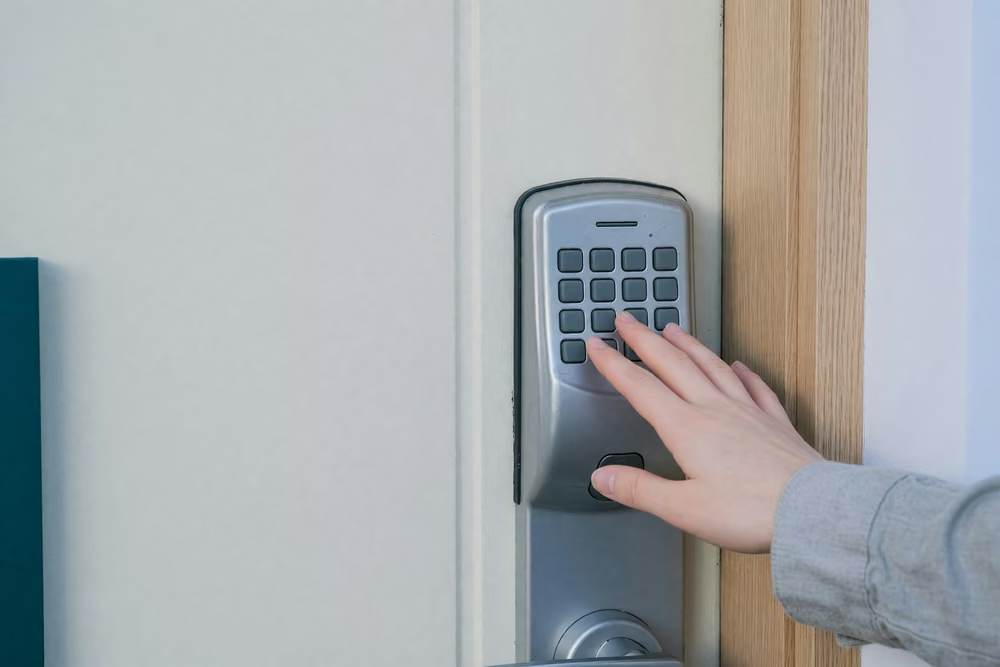
This is the point at which most owners stop managing themselves — not the cleaning and not the pricing. Trade sources accordingly name the electronic lock as one of the four layers of a well-run property, alongside management system, pricing and guest messaging. The reason is always the same: it uncouples the handover from being present.
For the rating the same thing counts a second time. A check-in that works without arrangement is one point of friction less — and friction on arrival shows up in the communication subcategory, which counts towards the strongest award.
The three routes, side by side
There are exactly three, and the choice turns less on money than on two other questions: who has to be present, and who has to agree.
| In person | Key safe | Electronic lock | |
|---|---|---|---|
| Purchase cost | none | CHF 60 – 200 | CHF 250 – 400 |
| Presence required | at every arrival and departure | no | no |
| Consent required | no | yes, if mounted outside | no for the flat door |
| Code per booking | not applicable | only by changing it by hand | yes, automatically |
| In a power cut | no problem | no problem | battery, spare key needed |
| Commonest cause of failure | delayed flight | code not reset | flat battery |
The Swiss special case: the master-key system
In a Swiss apartment building your flat door is, as a rule, part of a master-key system. One key opens the front door, the flat, the cellar and the laundry room, and it cannot be copied at a locksmith — it is protected and ordered through the manufacturer.
From which follows the real risk of short-term letting, and it appears in no yield calculation: a guest who loses the key does not lose a thirty-franc key. They lose access to the entire building. Whether the administrator then swaps only that one cylinder or has the whole system re-keyed is the administrator’s decision, not yours. In the second case it covers every cylinder and every key of every party, and the bill runs into four figures — in larger buildings five.
That is precisely why the choice between safe and electronic lock is not a cost calculation. An access code cannot be lost. It can be passed on — against which it helps that it stops working after departure.
Anyone staying with keys should settle two things before the first guest arrives: whether the contents or liability policy covers master-key damage at all, and whether it covers it under commercial use. The second question is the one it founders on.
Your figures, not our examples
The calculator takes the number of rooms, the neighbourhood and the fit-out and shows you a range — with the arithmetic beside it, not as a single figure you have to take on trust.
Estimate the returnWho has a say in the installation
Here what many take for a technical question splits into two legally different cases — and the line runs at the flat door.
- Your flat door is exclusive right. An electronic lock on the inside of the door changes nothing about communal substance and needs no consent. As a tenant you still need it — from the landlord.
- Front door, façade, stairwell and grounds are communal parts. A key safe screwed to any of them is an intervention in a communal part and a matter for the community.
- In practice: the lock on your own door is the route with the fewest parties involved. The safe on the façade is the route that can trigger a debate at the owners’ meeting — and the occasion on which short-term letting becomes a topic in the first place.
What we do in practice
An electronic lock on the flat door where the door allows it, with a code per booking that expires on departure. Plus a spare key held by us — not in the building, but with us — because a flat battery at midnight is worse than no lock.
The charge level belongs monitored, and automatically. That is the one point where electronic locks show their worth in practice: they report in good time, provided somebody reads the report.
Where the door takes no lock or the community will not have one, the safe remains, with a code changed after every stay — by hand, in the same pass as the cleaning. A code that stays the same for three months is not access control but a habit.
Frequently asked questions
For a lock on your own flat door, as a rule no — the door falls under your exclusive right. For a key safe on the façade, front door or stairwell, yes: those are communal parts, and the community decides. As a tenant you need the landlord’s consent in both cases.
If the flat is on a master-key system: not the key, but in the worst case the system. Whether only the cylinder is swapped or the whole thing re-keyed is the administrator’s decision, not yours. In larger buildings that runs into five figures. Check beforehand whether your insurance covers that loss under commercial use at all.
The lock can still be opened mechanically — which is why a spare key belongs somewhere, and not in the building. More important is that it does not come to that: the charge level belongs monitored, and the warning arrives weeks ahead. A dead lock at midnight is worse than no lock.
Yes, if the code is changed after every stay. That is exactly where it fails in practice: a code that stays the same for three months is no longer access control. Anyone who does not build the change into the cleaning routine but intends to get round to it will forget.
And for your property?
Sources
State of our research: 13 August 2026. Official rules change — check the current position with the competent authority.